
What is an IEC 60320 connector?
StayOnline has long been a go-to resource for those seeking to learn about power cords. Our resource center has been online since the early 2000s and has become a trusted authority for technical information about power cords. Today, we’re expanding on the information found in our IEC 320 Reference Chart.
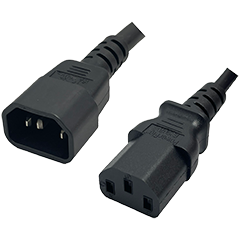
IEC 60320, commonly referred to as IEC 320, is a set of international standards that define non-locking1 appliance couplers. Published by the International Electrotechnical Commission, IEC 60320 plugs and connectors are widely used in both consumer and commercial electrical equipment. Even if you’ve never heard the term “IEC cord,” you almost certainly use one to power a computer, laptop, printer, or television.
The IEC 320 naming convention is straightforward. All designations begin with the letter “C”, followed by a one or two digit number. Odd numbers represent the female (equipment-side) connector, while even numbers represent the male (power-source-side) plug. In total, there are eleven IEC 60320 connector pairings - some extremely common, others far less so.
You may already recognize several of the shapes shown below, such as C5/C6, C7/C8, and C13/C14.
Reference Chart
| Configuration Female/Male |
International | North America | Wires | Poles | Notes |
|---|---|---|---|---|---|
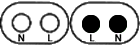 C1/C2 |
250 Volts 0.2 Amps |
125/250 Volts 0.2 Amps |
2 Wires | 2 Poles | Low-power, ungrounded connector for very small electronic devices; limited availability and uncommon in modern equipment. |
 C5/C6 |
250 Volts 2.5 Amps |
125 Volts 7 Amps 250 Volts 2.5 Amps |
3 Wires | 2 Poles | Grounded “cloverleaf” connector commonly used for laptop power supplies; not interchangeable with C7/C8. |
 C7/C8 |
250 Volts 2.5 Amps |
125 Volts 7 Amps 250 Volts 2.5 Amps |
2 Wires | 2 Poles | Ungrounded “figure-8” connector; widely used for consumer electronics; polarized and non-polarized variants exist. |
 C9/C10 |
250 Volts 6 Amps |
250 Volts 6 Amps |
2 Wires | 2 Poles | Ungrounded connector with higher current rating than C7/C8; relatively uncommon in North America. |
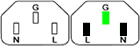 C13/C14 |
250 Volts 10 Amps |
125/250 Volts 15 Amps |
3 Wires | 2 Poles | Most common IEC connector for computers and IT equipment; standard temperature rating (70 °C inlet). |
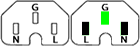 C15/C16 |
250 Volts 10 Amps |
125/250 Volts 15 Amps |
3 Wires | 2 Poles | High-temperature rated version of C13/C14 (120 °C inlet); keyed to prevent use with lower-rated C14 inlets. |
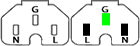 C15A/C16A |
250 Volts 10 Amps |
125/250 Volts 15 Amps |
3 Wires | 2 Poles | Extra high-temperature connector (155 °C inlet); used in hot environments such as professional kitchen or industrial equipment. |
 C17/C18 |
250 Volts 10 Amps |
125/250 Volts 15 Amps |
2 Wires | 2 Poles | Ungrounded version of C13/C14; less common; typically used where grounding is not required by the equipment design. |
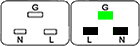 C19/C20 |
250 Volts 16 Amps |
125/250 Volts 20 Amps |
3 Wires | 2 Poles | High-current grounded connector for servers, PDUs, and data center equipment; not compatible with C13/C14. |
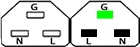 C21/C22 |
250 Volts 16 Amps |
125/250 Volts 20 Amps |
3 Wires | 2 Poles | High-temperature version of C19/C20; keyed to prevent mismating with standard-temperature C20 inlets. |
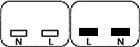 C23/C24 |
250 Volts 16 Amps |
125/250 Volts 20 Amps |
2 Wires | 2 Poles | Very rare IEC configuration; limited adoption and availability; typically not used in standard IT or commercial equipment. |
Summary
IEC 60320 connectors are a set of standards published by the IEC. They are very common, and chances are you have many in your home or workplace, the most common of which are the C14/C13, C7/C8 and C5/C6 variations. That’s all there is to it. Now you know what an IEC connector is, as well as information about the various types.
-
While the standard is for non-locking devices couplers, many locking options are available on the market. See https://www.stayonline.com/category/locking-data-center-cords.asp for locking variants. ↩