
The Anatomy of a UL Power Cord
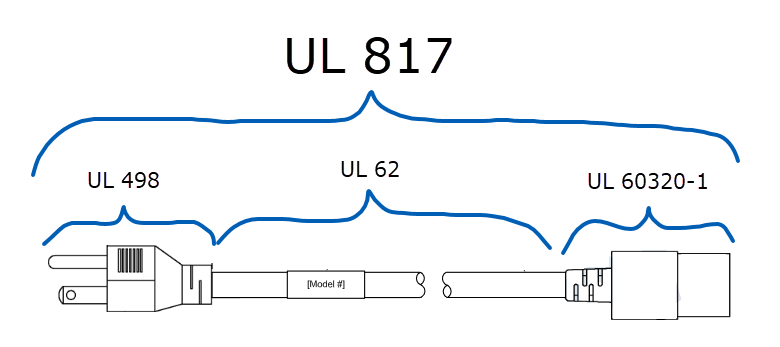
Welcome back to our series of posts about UL listed power cords. Previously we covered why a UL cord is more than just the sum of its parts. In this post we will describe the anatomy of a UL power cord including which standards apply to which components such as UL 498, UL 62, UL 60320-1 and ultimately, how they all tie together with UL 817.
Briefly, What is a finished UL power cord?
A complete cord assembly consists of one plug, a a flexible cord and one or more connectors. Plugs and connectors have terminals and strain relief and may be either molded or hand-assembled. Each component has its own requirements, but when combined they are known as a cord set or an assembly. What makes a cord UL listed is a combination of using UL components, following UL standards, UL required testing procedures and manufacture in a UL approved facility.
UL 498
UL 498 is the standard that applies to North American (NEMA) plugs and receptacles. It sets the rules for the mechanical strength, electrical performance, safety of plugs, connectors, and receptacles. It exists to ensure safe construction in order to prevent shocks, fires, and short circuits.
UL 62
UL 62 is the standard that regulates flexible electrical cord. It covers cords rated up to 600 Volts with an EV exception for up to 1000 volts for electric vehicle charging cables. It mandates strict testing for flame retardancy, insulation thickness, temperature endurance and oil resistance.
UL 60320-1
UL 60320-1 is UL’s North American safety standard that is harmonized with the IEC 60320 rules so that appliance couplers work across world markets. It sets safety standards and construction requirements for IEC connectors such as C14/C13 and C19/C20 among others.
UL 817
UL 817 is the standard to which the end-product must adhere. While a cord must be composed of a combination of components subject to the standards above, UL 817 evaluates the final assembly ensuring electrical rules are followed, the cord is tested, and is manufactured in an approved facility.
A practical example would be the typical 5-15P to C13 power cord. For a UL listed version of that product, the plug must meet UL 498, the cord must meet UL 62, and the connector must meet UL 60320-1. Once manufactured and tested in a UL approved facility, the end result is a UL listed power cord that meets UL 817 standards.
What about cULus?
Often you will see the cULus mark which is very similar to the UL mark. cULus means that the cord is approved for use in both the United States and Canada. Canada has its own standards that are lockstep with the UL standards. cULus is the mark used when both apply.
| U.S. (UL) | Canadian (cUL) |
|---|---|
| UL 817 | CSA C22.2 No. 21 |
| UL 62 | CSA C22.2 No. 49 |
| UL 498 | CSA C22.2 No. 42 |
| UL 60320-1 | CSA C22.2 No. 60320-1 |
Thus a cord built to the standards qualify as cULus which is a common marking on a power cord.
Lots of Standards
There are a lot of different standards at play to make sure the product you buy is safe to use. UL 498 covers North American plugs and receptacles, UL 62 defines standards for flexible wire, UL 60320-1 applies to appliance couplers such as C13. UL 817 dictates how they must be combined and tested. A cord must be made from UL listed parts, must pass rigorous tests, and must be produced in a UL approved facility in order to be considered UL listed.
For more information, you can reach us at 888-346-4688 or by email at sales@stayonline.com.