
Data Center Color Spaces - White, Gray, Green, and Beyond.
Data centers are often described using color-coded “spaces.” While these aren’t formal industry standards, they provide a practical shorthand for how facilities are organized, secured, powered, cooled, and expanded.
A recent LinkedIn post by David Korte clearly visualized these space categories and how they function together inside modern facilities (original post).
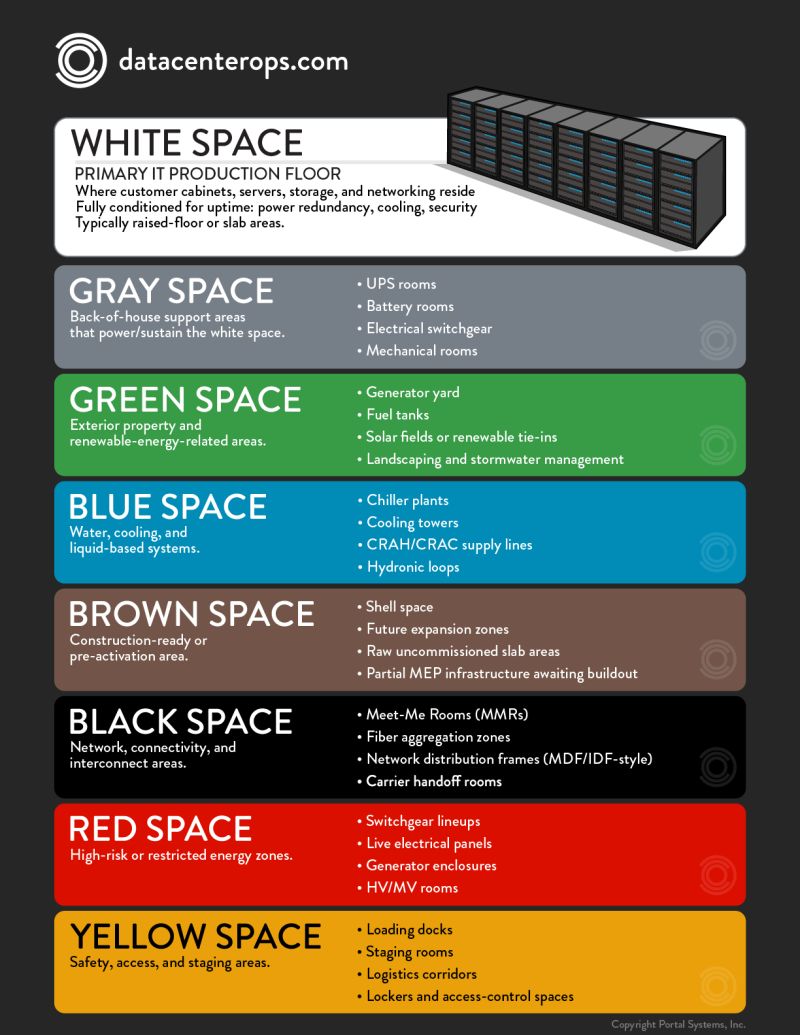
Here is a practical breakdown of the color spaces from the post.
White Space - The Production Floor
White space is what people typically think of when they think of a data center. Cabinets, servers, power cords, and networking cables and equipment are some of the features in this space. Cooling, security, air-conditioning and power redundancy also fit in this space. White space may have raised floors, or slab areas with overhead power drops.
Gray Space - Back of House
Gray space is found in the back of the house. It supports areas that provide power to sustain the white space. When you think of gray space, think mechanical rooms, battery rooms, UPS, breakers, and electrical switches.
Green Space - The Exterior and Renewable Energy Concerns
Green space, aptly named for the exterior of the property where renewable energy equipment may reside, is the space where you’ll find generators, fuel tanks, solar fields and renewable tie-ins. This space also includes landscaping and storm water management.
Blue Space - Water/Liquid Cooling
For facilities that use liquid and/or water based cooling, blue space is the domain of chiller plants, cooling towers, hydronic loops and CRAH/CRAC1 supply lines.
Brown Space - Construction Zones
Brown space refers to the construction-ready or pre-activation areas that are reserved for future expansion. Think uncommissioned slabs and partial infrastructure waiting for buildout. May be referred to as “shell space”.
Black Space - Networking & Connectivity
Black space is where the networking lives. Things such as Meet-Me Rooms (MMRs)2, fiber aggregation zones and network distribution frames live in the black space.
Red Space - High Risk Zones
Red space refers to restricted energy zones where switchgear and live electrical panels live. High voltage and medium voltage rooms are secure electrical spaces in data centers where utility power is received, transformed, switched, and distributed before it reaches UPS systems and IT loads. Red space is where the raw grid first enters the facility.
Yellow Space - Non-IT/Electrical Facility Concerns
Finally, we have yellow space. Yellow space encompasses things like loading docks, staging rooms, corridors, and access-control spaces.
Why the Color Model Matters
This color framework helps teams communicate clearly across operations, engineering, and sales. It allows for segmented risk, access control, and planning for expansion and capital projects. In short, it is a convenient way to explain facility layout to customers and stakeholders. It also reinforces an important reality: uptime isn’t just about racks. It’s about the coordinated interaction between white, gray, blue, green, red, black, brown, and yellow spaces. While not a formal standard, the color-coded model provides a useful mental map for understanding how modern data centers are structured and operated.
-
Computer Room Air Conditioner (CRAC) and Computer Room Air Handlers (CRAH) are precision cooling units used to control temperature and humidity. Hydronic loops are closed piping systems that circulate water (or a water-glycol mix) to move heat from one place to another. ↩
-
A meet-me room (MMR) is a secure, shared space inside a colocation or carrier-neutral data center where different telecommunications carriers physically connect their networks to customers and to each other. It’s essentially the interconnection hub of the facility. ↩