
The Complete Guide to Cam Lock Connectors
Introduction
Cam lock connectors are the backbone of modern temporary power systems—used everywhere from generator hookups and construction sites to live events, data centers, and emergency power deployments. Yet despite how common they are, reliable information about camlocks is surprisingly fragmented across manufacturer spec sheets, forum threads, and narrowly focused blog posts. This guide brings everything together in one place.
To make it easy to navigate, use the links below to jump directly to the section you need—or read straight through for a complete understanding of electrical cam lock connectors.
Disambiguation:
This guide focuses exclusively on electrical single-pole cam lock connectors used for temporary power distribution, not plumbing cam-and-groove fittings or furniture cam locks.
Who This Guide Is For
If you’re responsible for choosing, installing, or maintaining cam lock connectors—and want to be confident about series selection, color codes, compatibility, and code considerations—this guide is built for you.
Table of Contents
- What Are Cam Lock Connectors?
- Camlock Series Comparison
- Cam Lock Color Codes by Voltage
- Cross-Brand Compatibility
- Cam Lock vs. Posi-Lok vs. Powerlock
- Applications by Industry
- Termination Types — Double Set Screw vs. Crimp
- NEC Code Requirements & Safety
- How to Choose the Right Cam Lock Connector-
What Are Cam Lock Connectors?
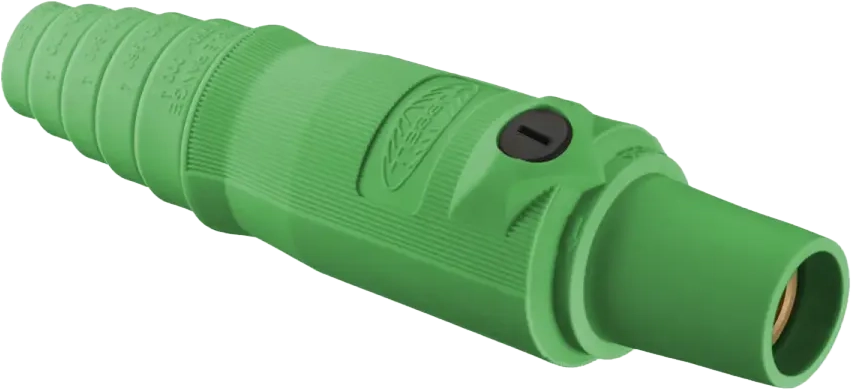
Cam lock connectors—also commonly written as camlock connectors—are single-pole electrical connectors used to make high-current power connections quickly, safely, and without tools. They are most often found in temporary power distribution systems where speed, flexibility, and reliability matter more than permanent wiring methods.
Right up front, it’s worth clearing up a common source of confusion. When people search for “cam lock connectors,” they may be thinking of plumbing cam-and-groove fittings or the small cam locks used in flat-pack furniture. This guide is not about those. Everything here refers specifically to electrical cam lock connectors designed for power distribution.
At their core, cam lock connectors are interchangeable, single-conductor connectors that are combined in sets—typically five—to carry three-phase power: three phase conductors, one neutral, and one equipment ground. Rather than bundling all conductors into a single multi-pin plug, each conductor is handled independently. This means a standard three-phase circuit requires five individual cam lock connections: three phases, a neutral, and a ground. That might sound like more work than a single multi-pole connector, but there’s a practical reason for it. At the amperage levels these connectors handle — typically 150A to 690A depending on the series — multi-conductor cables become too heavy, too stiff, and too difficult to route. Single-pole connections with individual cables solve that problem.
The term “Cam-Lok” originally came from a trade name used by Eaton / Crouse-Hinds, but over time it became the generic name for this entire connector category. Today, manufacturers like Hubbell, Leviton, Marinco, Ericson, and others all produce cam lock connectors that follow the same industry standards and mate with one another.
What makes cam lock connectors especially well suited for temporary power is how they connect. Each connector uses a spring-loaded cam mechanism that locks the male and female contacts together with a short twist of the wrist. No wrenches, screws, or special tools are required. This allows trained personnel to connect and disconnect high-amperage circuits quickly while maintaining a secure mechanical and electrical connection.
Cam lock connectors are most commonly used anywhere power demands exceed what standard plugs can handle—generally above 100 amps and up into the 400-amp range and beyond. Typical applications include portable generators, load banks, temporary building service connections, event power distribution, construction sites, emergency backup power, and industrial maintenance shutdowns.
In short, cam lock connectors are the backbone of modern temporary power: fast to deploy, rugged enough for the field, and flexible enough to work across industries and manufacturers.
Camlock Series Comparison
Not all cam lock connectors are the same. While they may look similar at a glance, different camlock series are designed for very different cable sizes, amperage ranges, and environments. Understanding these differences is critical when selecting connectors that are safe, compatible, and appropriate for your application.
The table below provides a side-by-side comparison of the most common camlock series used in North America and industrial power applications.
Camlock Connector Series Comparison
| Series | Common Name | Wire Gauge Range | Max Amperage* | Typical Applications |
|---|---|---|---|---|
| Series 15 | Mini Cam | #8 – #2 AWG | 150A | Entertainment lighting, small generators, light-duty temporary power |
| Series 16 | Standard Camlock | #2 – 4/0 AWG | 300–400A | Industry standard for generators, construction, events, rental power |
| Series 17 | Heavy-Duty | 350 – 750 MCM | Up to 690A | Heavy industrial, mining, ship-to-shore power |
| Series 18 | Ball Nose | #2 – 4/0 AWG | 300–400A | Wet or outdoor environments requiring splash-tight sealing |
| Series 22/23 | Latching Camlock | 350 – 750 MCM | Up to 690A | High-vibration ship-to-shore, naval and marine shore power |
*Maximum amperage depends on cable size, insulation type, and installation method—not the connector alone.
Series 16: The Industry Standard
If you hear someone refer to “camlocks” without specifying a series, they are almost always talking about Series 16. This series has become the de facto standard for temporary power in North America.
Series 16 camlock connectors support cable sizes from #6 AWG up to 4/0 AWG, allowing them to handle 300 to 400 amps depending on conductor size and system design. This range perfectly matches the output of most portable generators and temporary distribution equipment, which is why Series 16 connectors are what rental houses stock, generator panels are built around, and electricians expect to see in the field.
For most buyers, Series 16 is the correct answer unless there is a specific reason to choose something else.
Series 15: Mini Camlocks
Series 15 connectors—often called Mini Cams—are a smaller, lighter-duty version of standard camlocks. They are designed for cable sizes from #8 to #2 AWG and are typically rated around 150 amps.
These are common in entertainment and stage lighting applications where space and weight matter, but full 400A capacity is unnecessary. They are not a substitute for Series 16 in generator or construction environments.
Series 18: Ball Nose vs. Taper Nose
Series 18 connectors are electrically similar to Series 16—they use the same cable sizes and amperage ranges—but differ in mechanical design.
-
Series 16 uses a taper nose design
-
Series 18 uses a ball nose design with improved sealing
The ball nose creates a splash-tight connection, making Series 18 better suited for outdoor, marine-adjacent, or wet environments. However, Series 18 connectors are less common and may not be as universally available as standard Series 16 connectors.
Series 17, 22, and 23: High-Amperage & Latching Designs
Series 17 connectors move into heavy-duty territory, supporting very large conductors (up to 750 MCM) and amperage levels approaching 690 amps. These are used in mining, large industrial facilities, and specialized infrastructure projects.
Series 22 and 23 add a mechanical latching mechanism designed to resist vibration and accidental disconnection. This makes them the preferred choice for naval and ship-to-shore power, where movement and mechanical stress are unavoidable.
One Important Clarification on Amperage
A common misconception is that amperage is determined solely by the camlock series. In reality, the cable gauge is just as important as the connector itself. A Series 16 connector can be part of a 300A or 400A assembly depending on the conductor size used.
This is why professional temporary power systems are always specified as a connector + cable assembly, not a connector alone.
Cam Lock Color Codes by Voltage
Cam lock connector color codes exist to make temporary power systems faster to deploy and safer to connect, especially in environments where cables are frequently handled, disconnected, and reconfigured. While color coding is widely followed across the industry, it’s important to understand what is code-required versus what is convention.
At a high level, cam lock color codes identify ground, neutral, and individual phase conductors in a multi-phase system. This allows qualified personnel to visually verify connections and reduce the risk of mis-phasing equipment.
What the NEC Actually Requires
The National Electrical Code (NEC) only mandates color identification for two conductors:
-
Equipment Ground: Green (NEC 250.119)
-
Neutral (Grounded Conductor): White or Gray (NEC 200.6)
The colors used for phase conductors (L1, L2, L3) are not mandated by the NEC. They are industry-standard conventions that have become widely adopted to reduce errors and improve consistency across temporary power setups.
Common Cam Lock Color Codes by Voltage
Below are the most commonly used color conventions in North America for cam lock connectors.
120/208V or 120/240V Three-Phase Systems
| Function | Color |
|---|---|
| Ground | Green |
| Neutral | White |
| Line 1 (L1) | Black |
| Line 2 (L2) | Red |
| Line 3 (L3) | Blue |
This is the most common configuration used for portable generators, construction sites, and event power distribution.
277/480V Three-Phase Systems
| Function | Color |
|---|---|
| Ground | Green |
| Neutral | White |
| Line 1 (L1) | Brown |
| Line 2 (L2) | Orange |
| Line 3 (L3) | Yellow |
This color set is typically used in industrial and commercial environments where higher-voltage distribution is required.
600V Systems
| Function | Color |
|---|---|
| Ground | Green |
| Neutral | White |
| All Phases | Black |
At 600V, phase conductors are often all black and distinguished by labels or markings rather than color alone. This approach reflects the expectation that only trained professionals are handling these systems.
Entertainment Industry Gender Convention
In entertainment and live-event power systems, there is a commonly used—but not universal—practice related to connector gender:
-
Ground and Neutral connectors are often reversed in gender relative to phase conductors
-
This is intended to reduce the risk of energizing exposed connectors during setup
It’s important to note that this convention varies by region, company, and production, and should never be assumed without verification.
Best Practice: Color Is a Guide, Not a Guarantee
Color coding is a valuable safety aid, but it is not a substitute for proper verification. Cables may be mislabeled, reused, or assembled incorrectly over time.
Best practice always includes:
-
Verifying voltage and phase rotation with test equipment
-
Confirming grounding and neutral integrity
-
Following proper connection sequence procedures
In temporary power environments, trust the meter—not just the color.
Cross-Brand Compatibility
One of the most common questions about cam lock connectors is also one of the simplest:
Are cam lock connectors interchangeable between manufacturers?
For standard cam lock connectors, the answer is yes—with important caveats.
Standard Camlocks Are Interchangeable
Most cam lock connectors used in temporary power today fall under the E1016-style standard (commonly referred to as Series 16 taper nose). Connectors built to this standard are designed to mate mechanically and electrically across manufacturers.
This means cam lock connectors from major brands—including Eaton, Hubbell, Leviton, Marinco, Ericson, and others—are generally fully interchangeable when they are the same series, voltage class, and gender.
Rental companies, generator manufacturers, and temporary power providers rely on this interchangeability. It allows equipment from different sources to work together seamlessly on job sites, events, and emergency deployments.
Why Interchangeability Works
Historically, cam lock connectors were listed by UL as manufacturer-specific. That created uncertainty about mixing brands. Years ago, UL revised the standard so that compliant cam lock connectors are now listed to a common dimensional and performance requirement, rather than tied to a single manufacturer.
As a result, modern UL-listed E1016 cam lock connectors are intended to be cross-compatible by design.
Important Exceptions to Know
While standard camlocks are interchangeable, not all single-pole connectors are camlocks.
-
Posi-Lok connectors are not compatible with standard cam lock connectors. They use a different mating design with a sequential interlock mechanism.
-
Powerlock / Powersafe connectors are a completely different connector system, commonly used in Europe. They will not mate with cam lock connectors under any circumstances.
-
Mixing different series (for example, Series 16 with Series 17) is not permitted, even if they appear similar.
What This Means in Practice
If you are working with generator panels, rental equipment, or temporary power systems, Series 16 cam lock connectors are the universal language. Matching the correct series, color, and gender is what matters—not the brand name on the connector body.
This cross-brand compatibility is one of the key reasons cam lock connectors remain the dominant solution for temporary power in North America.
Cam Lock vs. Posi-Lok vs. Powerlock
Single-pole connectors all solve the same basic problem—delivering high-amperage power safely and efficiently—but they do it in different ways. Cam lock, Posi-Lok, and Powerlock connectors are not interchangeable, and each system reflects a different balance between speed, safety features, regional standards, and cost.
Understanding these differences helps explain why cam locks remain dominant in North America, while alternatives continue to gain traction in specific use cases.
Feature Comparison Overview
| Feature | Cam Lock (E1016) | Posi-Lok | Powerlock / Powersafe |
|---|---|---|---|
| Typical Amperage | Up to 400A (Series 16) | 400A–800A | 400A–800A |
| Connection Method | Cam-action twist lock | Threaded, sequential interlock | Keyed, locking multi-contact |
| Safety Design | Color-coded, no exposed contacts when mated | Ground connects first, disconnects last | Finger-proof, IP-rated, mechanically keyed |
| NEC Considerations | General use | Meets NEC 520-53(K) | Exceeds many US/EU safety standards |
| Cross-Brand Compatibility | Fully interchangeable | Eaton proprietary | ITT Veam + compatible manufacturers |
| Regional Adoption | Dominant in North America | North America (entertainment) | Standard in Europe, growing in US |
Cam Lock Connectors
Cam lock connectors are the workhorse of temporary power in North America. Their strength lies in simplicity: a fast, tool-free connection, broad cross-brand compatibility, and decades of field use.
They are widely accepted in generator hookups, construction sites, rental power, and industrial maintenance because crews already know how to use them and infrastructure is built around them. While cam locks rely heavily on procedural safety and trained personnel, their proven reliability and availability make them the default choice for most applications.
Posi-Lok Connectors
Posi-Lok connectors were developed to address safety concerns in entertainment and live event power, where frequent connections are made in public-facing environments.
Their defining feature is a sequential interlock that ensures the ground conductor connects first and disconnects last. This design aligns with NEC Article 520-53(K), making Posi-Lok a common requirement for certain entertainment venues and productions.
The tradeoff is compatibility. Posi-Lok connectors are proprietary to Eaton and will not mate with standard cam locks. This limits flexibility when mixing equipment from different sources.
Powerlock / Powersafe Connectors
Powerlock (also marketed as Powersafe) connectors represent a more modern approach, emphasizing mechanical keying, finger-safe contacts, and environmental sealing. They are the standard temporary power connector throughout much of Europe and are increasingly specified in high-profile installations in the U.S.
Powerlock systems offer excellent safety and durability but require dedicated infrastructure and matching connectors on all equipment. They are not backward-compatible with cam locks, which can make adoption costly in environments already built around camlock systems.
Which One Is “Best”?
There is no universally “better” connector—only one that fits the regulatory, operational, and logistical realities of a given job.
-
Cam locks remain the best choice for general temporary power where flexibility, availability, and compatibility matter most.
-
Posi-Lok excels in regulated entertainment environments where sequential grounding is required.
-
Powerlock is ideal for purpose-built systems prioritizing maximum safety and environmental protection.
For most generator hookups, rental power, and construction applications, cam lock connectors continue to be the practical standard—not because they are the newest, but because they work everywhere, with everything.
Applications by Industry
Cam lock connectors are used across a wide range of industries, but the underlying reason is always the same: they allow high-amperage power to be deployed quickly, reconfigured easily, and removed without permanent wiring. Below are the most common industries where cam lock connectors are essential, along with how they are typically used in the field.
Entertainment & Live Events
Concerts, festivals, film sets, and touring productions rely heavily on cam lock connectors to distribute power to lighting, audio, video walls, and staging equipment. Portable generators and temporary distribution panels commonly use Series 16 camlocks to feed spider boxes and breakout panels. In these environments, speed of setup and teardown is just as important as capacity.
Construction Sites
Construction projects often require temporary power long before permanent electrical service is available. Cam lock connectors are used to connect generators to temporary distribution panels that supply trailers, tools, site lighting, and temporary HVAC. Their durability and ability to handle frequent connect/disconnect cycles make them ideal for long, multi-phase projects.
Emergency & Disaster Relief
During outages caused by storms, fires, or infrastructure failures, cam lock connectors enable rapid generator deployment to hospitals, shelters, data centers, and municipal facilities. Pre-installed camlock panels allow emergency crews to bring power online in minutes rather than hours, which is why camlocks are a standard feature in many emergency preparedness plans.
Oil, Gas & Mining
Remote and harsh environments demand rugged power distribution systems. Cam lock connectors are used to supply power to pumps, compressors, lighting, and processing equipment in oil fields, refineries, and mining operations. In these settings, heavier cable assemblies and higher-duty connectors are often paired with protective boots and strain relief.
Ship-to-Shore & Naval Power
Marine and naval applications frequently require specialized connectors capable of handling vibration, movement, and high current. While standard camlocks may be used in some dockside scenarios, Series 22 and 23 latching camlocks are commonly specified for ship-to-shore power connections where accidental disconnection cannot be tolerated.
Data Centers
Data centers use cam lock connectors primarily for temporary power during maintenance, testing, or upgrades. Load banks, temporary generators, and UPS testing equipment are often connected using camlocks at the facility level, while rack-level equipment relies on IEC and NEMA power cords. This overlap makes temporary power planning a critical part of data center operations.
Generator Rental & Standby Power
Generator rental companies are one of the largest users of cam lock connectors. Most portable generators are equipped with Series 16 camlock output panels, allowing them to connect quickly to customer equipment or distribution systems. For standby generators, camlock panels provide a safe and repeatable way to test and deploy backup power without hardwiring.
Across all of these industries, the common thread is flexibility. Cam lock connectors allow power systems to scale, adapt, and move as needs change—without redesigning the entire electrical setup each time.
Termination Types — Double Set Screw vs. Crimp
When selecting cam lock connectors, the termination method is just as important as the series or amperage rating. The way the conductor is secured inside the connector directly affects serviceability, reliability, and suitability for portable versus permanent use.
Most cam lock connectors fall into one of three termination categories: double set screw, crimp tube, or factory-molded. Each serves a different purpose.
Double Set Screw Termination
Double set screw connectors use two opposing screws to mechanically clamp the conductor in place.
This is the most common termination style for cam lock connectors, especially in temporary and rental power environments. The primary advantage is serviceability. Cables can be installed, removed, or replaced in the field using standard hand tools, without specialized equipment.
Double set screw terminations are ideal for:
-
Generator rental fleets
-
Temporary power distribution
-
Event and construction applications
-
Situations where cables may be re-terminated or resized over time
Because of their flexibility and ease of maintenance, double set screw camlocks are widely considered the industry standard for portable power.
Crimp Tube Termination
Crimp-style cam lock connectors secure the conductor using a crimped copper tube, typically installed with a hydraulic crimp tool.
This method creates a very solid, low-resistance connection and is often preferred in permanent or semi-permanent installations where the cable will not need to be serviced regularly. The tradeoff is that crimp terminations are not field-friendly—changing a cable requires cutting the conductor and re-crimping with the correct tooling.
Crimp terminations are best suited for:
-
Fixed installations
-
OEM cable assemblies
-
Long-term industrial connections
-
Environments where vibration is minimal
Factory-Molded or Vulcanized Assemblies
In some cases, cam lock connectors are molded or vulcanized directly onto the cable at the factory. This produces the strongest mechanical connection and provides excellent strain relief and environmental protection.
These assemblies are typically used where maximum durability is required and on-site modification is not expected.
Choosing the Right Termination
As a general rule:
-
Choose double set screw for portable, rental, or frequently reconfigured systems
-
Choose crimp for permanent or OEM-style installations
-
Choose factory-molded when maximum durability and minimal handling are the priority
Selecting the correct termination method helps ensure the connector performs as intended throughout its service life—not just on day one.
NEC Code Requirements & Safety
Cam lock connectors are widely used in professional environments, but they are not general-purpose connectors. Their use is governed by specific NEC articles, UL listing requirements, and established safety practices. Understanding these rules is essential for compliance, inspection approval, and—most importantly—safe operation.
NEC Articles That Commonly Apply
Several sections of the National Electrical Code are directly relevant to cam lock connectors:
-
NEC 250.119 — Requires the equipment grounding conductor to be identified by green insulation (or green with yellow stripe).
-
NEC 200.6 — Requires the grounded (neutral) conductor to be identified by white or gray insulation.
-
NEC 520-53(K) — Applies to entertainment and stage power, requiring a sequential interlock so the grounding conductor connects first and disconnects last. This is where systems like Posi-Lok are often specified.
It’s important to note that outside of Article 520 (entertainment), the NEC does not universally require sequential interlock connectors. Standard cam lock connectors remain acceptable in many temporary power applications when used correctly.
UL Listing and Product Standards
Cam lock connectors should always be UL listed, typically under UL 498 for attachment plugs and connectors. A proper listing confirms that the connector meets requirements for dielectric strength, temperature rise, mechanical durability, and fault performance.
When selecting connectors:
-
Verify the UL mark is present on the connector body
-
Confirm the listing applies to the connector type and amperage being used
-
Ensure the connector rating matches the cable size and insulation
Mixing listed connectors with improperly rated cable assemblies is a common inspection failure point.
Qualified Personnel Requirement
Cam lock connectors are intended for use by qualified persons only. They are not designed for untrained users or consumer environments.
Because camlocks expose energized conductors during connection and disconnection, safe operation relies on:
-
Proper connection sequence (ground first, ground last)
-
De-energizing when possible
-
Use of appropriate PPE
-
Verification with test equipment
These procedural safeguards are a core assumption built into NEC acceptance of cam lock systems.
Safety Best Practices in the Field
Even when fully code-compliant, cam lock connectors require disciplined handling:
-
Always connect ground first, then neutral, then phases
-
Disconnect in the reverse order
-
Never rely solely on color coding—verify voltage and phase
-
Inspect connectors regularly for heat damage, cracking, or loose hardware
Cam lock systems are safe when used correctly, but they do not compensate for poor procedure or improper installation.
Why Camlocks Are Still Accepted
Despite newer connector systems offering additional built-in safeguards, cam lock connectors remain widely accepted because they are used in controlled, professional environments with trained personnel and established procedures.
When properly specified, installed, and operated, cam lock connectors fully meet NEC requirements for temporary power distribution.
How to Choose the Right Cam Lock Connector
With multiple series, color codes, termination types, and mounting options available, choosing the right cam lock connector can feel more complicated than it needs to be. In practice, most decisions follow a simple, repeatable process.
Use the steps below to select the correct connector for your application.
Step 1: Determine Your Amperage Requirement
Start with the current your system needs to carry. Most applications fall into one of three ranges:
-
Up to 150A — typically Series 15 (Mini Cam)
-
300–400A — Series 16 or Series 18 (most common)
-
690A and above — Series 17, 22, or 23
Generator output ratings, load bank specs, and distribution equipment will usually dictate this requirement.
Step 2: Select the Correct Camlock Series
Once amperage is known, choose the series that supports both the current level and cable size:
-
Series 16 is the standard choice for most generator, rental, and construction applications
-
Series 18 is selected when splash resistance or wet environments are a concern
-
Higher series are reserved for heavy industrial or marine use
When in doubt, match what existing equipment already uses—especially in rental or multi-vendor environments.
Step 3: Choose Color Configuration by Voltage
Select connector colors based on your system voltage:
-
Black / Red / Blue for 120/208V or 120/240V systems
-
Brown / Orange / Yellow for 277/480V systems
-
All black phases for 600V systems
Always include green for ground and white for neutral, and verify the configuration against the equipment being connected.
Step 4: Inline vs. Panel Mount
Decide how the connector will be installed:
-
Inline connectors are used on portable cable assemblies and extension leads
-
Panel mount connectors are installed on generator panels, distribution boxes, and building inlets
Many systems use both, so compatibility between mating connectors is critical.
Step 5: Select the Termination Type
Match the termination method to how the system will be used:
-
Double set screw for portable, rental, or frequently reworked cables
-
Crimp termination for permanent or OEM-style installations
-
Factory-molded assemblies for maximum durability with no field modification
This choice affects long-term maintenance just as much as electrical performance.
Step 6: Verify Gender and Mating Requirements
Ensure you are ordering the correct male and female connectors for each conductor. Generator outputs, building inlets, and distribution panels may all use different gender conventions depending on the application.
Always confirm mating orientation before ordering, especially when replacing or expanding existing systems.
Final Check Before You Order
Before committing to a connector selection, confirm:
-
Amperage and cable gauge alignment
-
Voltage and color configuration
-
Series compatibility with existing equipment
-
NEC and application-specific requirements
Ready to Source Your Connectors?
Once these steps are complete, you can confidently select connectors that will integrate cleanly into your power system.
Browse StayOnline’s full selection of single-pole cam lock connectors and cordsets to find inline, panel mount, and cable-ready options from trusted manufacturers—available for temporary power, industrial, and data center applications.
Conclusion
Cam lock connectors remain the standard for temporary power because they strike the right balance between capacity, speed, and flexibility. When you understand the differences between series, follow established color conventions, and choose connectors that match your application and code requirements, camlocks become a reliable, repeatable solution across industries.
Whether you’re deploying a generator, building out temporary distribution, or planning maintenance power, the key is consistency—using the right series, the right terminations, and components that are compatible with the equipment already in the field.
With that foundation in place, cam lock connectors do what they’ve always done best: deliver high-amperage power exactly where it’s needed, when it’s needed, without unnecessary complexity.
For more information, you can reach us at 888-346-4688 or by email at sales@stayonline.com.